By Melanie Regnier
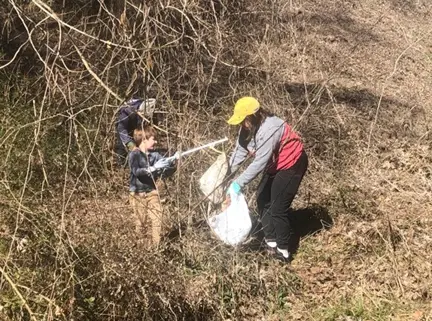
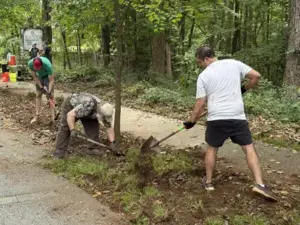
Volunteers cleaning up trash at Tapestry
During my last walk through the Tapestry Greenspace (off United Avenue), I found Tapestry neighbor Julie Lowring weeding around the blueberries planted near the water pipe. She had news: Tapestry was selected as a recipient of the 2026 Rivers Alive Adopt-A-Stream Award, in acknowledgement of their work conducting trash cleanups and monitoring the water quality in the stretch of Intrenchment Creek that runs through the property within the riparian buffer. I nodded, pretending I understood the phrase “riparian buffer”, and ran home to look up its meaning, nearly tripping over a beautiful box turtle that was trying to cross the pipe.
Here’s what I learned. A riparian buffer is the vegetation–trees, shrubs, native plants, and grasses–that grows along streams and rivers, controlling erosion, filtering storm runoff, and providing habitat for wildlife. The section of Intrenchment Creek that runs through Tapestry was once kudzu-choked and filled with tires and trash. You might have called it a very sickly riparian buffer. The Tapestry Community (formed as a neighborhood block association that owns the land) came together to push back the kudzu and clear the trash from the creek. In 2008, a 30-yard dumpster was filled with trash and over 100 tires. Subsequent grants and assistance (via the Five Star and Urban Waters Restoration Program, Trees Atlanta, and the Atlanta Audubon Society, among others) enabled the community to plant hundreds of trees and native plants, establish a meadow of wildflowers, milkweed, and American Beautyberry, build owl and bluebird houses, and provide educational opportunities to middle school students. Biannual clean-up events over the years have removed tons of trash and debris that continually wash downstream.
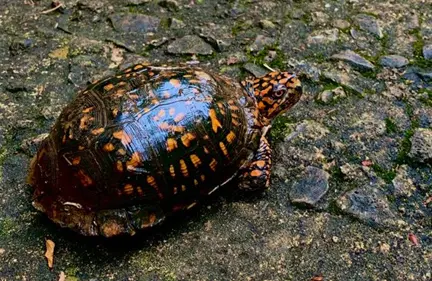
A box turtle on the pipe at Tapestry
So improved was the riparian buffer that a pair of beavers showed up in 2014, building a six-foot-high dam across the creek. “It was a challenge to coexist,” said Lowring, “because everything we planted became the next meal for the beavers. But the biodiversity the beavers created was incredible, and we miss them.” During the beaver’s tenure, herons, ducks, and geese were regularly sighted on the property. Sadly, the beavers disappeared in 2021.
Water quality testing started in 2010, when Lowring teamed up with Tapestry neighbor Lou Clymore to take an Adopt-A-Stream class through the City of Atlanta, an outreach program of Georgia’s Environmental Protection Division. They learned how to monitor the health of the creek, measuring levels of bacteria, oxygen, pH, and water and air temperature. Neighbor Bob Bourne soon joined the effort. Their water quality data, dating back to 2010, is posted online on the Georgia Environmental Protection Division’s Adopt a Stream site. Intrenchment Creek is part of the watershed that flows into the South River, the Ocmulgee, the Altamaha, and finally the Atlantic near Darien, Georgia.
In 2022, a conservation easement was placed on the Tapestry’s seven acres, held by the Southeastern Trust for Parks and Land. This easement protects the land from future development and preserves it as a greenspace in perpetuity. The Tapestry Community has always welcomed neighbors to visit the Greenspace, which can be entered from United Avenue just west of Walker Avenue and the corner of Walker and Eden Avenues.
Maintaining the health of the Tapestry Greenspace and its riparian buffer is no small effort. It’s a true labor of love that has knit the Tapestry Community together for decades. “Nature is ever evolving and we have learned to evolve with it,” said Lowring. “It is a humbling experience.” Volunteer workdays are held regularly to remove weeds and invasives, plant native plants, and gather trash from the creek. Tapestry partners with Park Pride. Tapestry relies heavily on private donations, its only financial support, which covers maintenance tasks such as mowing, tree trimming and removal, native plant material, and equipment/playground maintenance.
More information about Tapestry’s history, volunteer opportunities, and how to donate can be found at tapestrygreenspace.org, or scan the QR codes posted on signs within the Greenspace.