By Paul Bolster
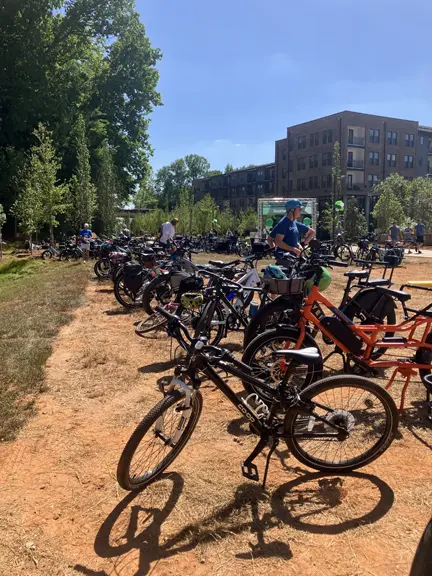
Bikes parked at the opening ceremony
The Southeast Beltline’s opening ceremony was on April 16. Mayor Andre Dickens, Beltline CEO Clyde Higgs, and local members of the Atlanta City Council, Board of Atlanta Public Schools (APS), and Fulton County Commission were among those gathered to officially open the 1.2 miles of Sections 4 and 5 that connect Glenwood to Boulevard. The project follows the border between the SAND neighborhoods of Ormewood Park, Boulevard Heights, and Grant Park. Entrance ramps at Ormewood and United Avenues will need two more months to complete. When the two sections of the Southside Trail starting at Boulevard are completed in June, Higgs said that the trail will have 16.7 miles of continuous paving.
Connection was the theme for the day. Mayor Dickens praised the Beltline for “bringing people together in a way that is truly special and bringing our city closer together.” Katie Howard, District 1 member of the APS board, celebrated the opportunity that this section of the Beltline creates “to connect the students of these neighborhoods to area public schools.” The ceremony took place in Maynard Jackson High School’s back yard and close to Parkside Elementary.
The project was a collaboration between all three local governments. Through the efforts of U.S. Sen. Jon Ossoff, some sections of the Beltline have received federal transportation dollars, but the capital funds for this project came predominantly from the Beltline Tax Allocation District (TAD). The district was established in 2005. Since then, the property tax on the increased value in the district has gone into the TAD fund. So, if you live near the Beltline, some of your property tax dollars paid for the construction. Maynard Jackson, who, as mayor, proposed the original state legislation that authorized TAD funding, would have been pleased to see the results of his foresight. The lack of federal funds for this section of the project could be seen in the absence of federal officials at the ceremony.
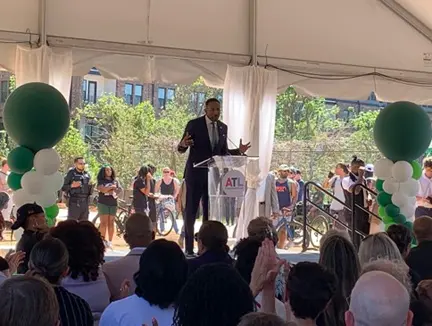
Mayor Dickens speaking at the Beltline opening.
Jason Winston, District 1 member of the Atlanta City Council, focused attention on the neighbors. He believes the Beltline is transformative: “My constituents have been clear about wanting safer, better-connected neighborhoods in southeast Atlanta.” He is also interested in what comes next. “We need affordable housing so that the people who live here can stay here, and that includes the people of the two Trestletree Villages.” TAD funds also support the development of affordable housing. So, if the Trestletree Villages apartment complexes are redeveloped, as proposed, TAD funds are likely to play a role in those projects.
Fulton County Commission Chair Robb Pitts highlighted the partnership between the county, the city, and Atlanta Public Schools that made the capital investment possible. Approximately 50% of the property tax rate is set by the APS Board and 25% each by the city and the county.
One neighbor said, “It’s exciting and about time. Walking and biking are good, but it would be great if there was also rail.” Grant Park Neighborhood Association (GPNA) President Robert Selby saw the ceremony as “the opening of the southside to development.” “It’s a great way to move around the neighborhood with a focus on safety,” said Kyle Wade, resident of Ormewood Park who attended the ceremony with his wife and daughter. Wade takes his daughter to school and to soccer on his bike. His daughter Cassie, who attends the Trees Atlanta summer camp on the Beltline, says “it’s a beautiful gallery for the neighborhood.” Wade’s neighbor Megan Watters said it’s exciting “to be able to bike to small businesses in the area.”
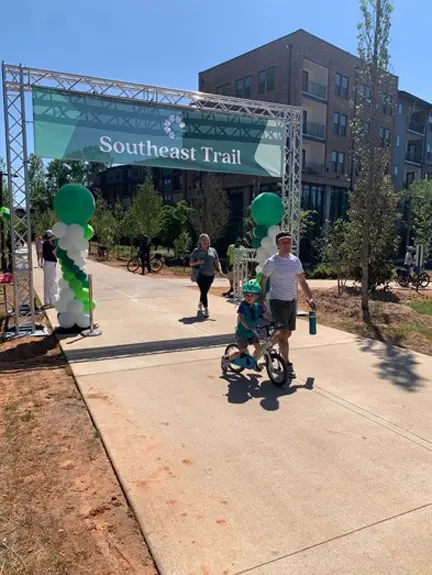
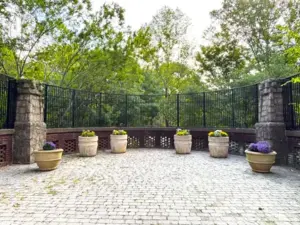
The entrance to the new Southeast Trail segment
Many of the Beltline Ambassadors were at the ceremony. Decked out in bright yellow uniforms, they were ready to ride the new miles and offer assistance to any traveler. They are trained in and equipped for first aid. Like the Downtown Ambassadors, they are there to keep a watchful eye on behavior and can make a quick connection to law enforcement if needed. An Atlanta police task force also patrols the current 16 miles. Funding for the Ambassadors comes from the Atlanta Beltline Partnership, Inc., a nonprofit organization receiving charitable contributions.
Many other benefits, both present and future, are proposed to come with the new construction. If you watched the construction closely, you saw orange conduits sticking out of the ground. The entire Beltline loop will be linked with fiber optic cable for connections to businesses along its path. At some time in the future, the city may contract with an internet provider to make available internet services at a discounted rate. Numerous free fitness programs are planned or currently operating along the path. The Empowerment Program of the Atlanta Beltline Partnership has offered seminars and assistance to homeowners who wish to appeal the rising assessment on their homes. Help is available for some “legacy residents” whose tax liability threatens their ability to stay living near the Beltline.