By Joel Feingold
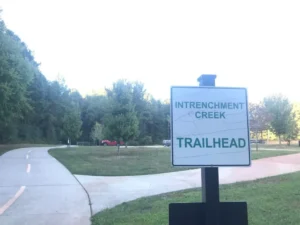
The swap pertains to land in DeKalb County’s Commission District 3 that was donated to DeKalb County in 2003 via a Limited Warranty Deed from the Trust for Public Land (TPL). This land near the South River and the new Police Training Facility south of East Atlanta was given to TPL by The Arthur Blank Family Foundation via a deed specifying that the land be given to DeKalb County. It is a 135-acre expanse bordered by Constitution Road on the south and Fayetteville Road on the east.
The deed is specified as a limited warranty deed for two reasons. Though it names DeKalb County as the deed’s holder, it restricts County powers over Intrenchment Creek Park’s (ICP) development. It requires that the county maintain the land in perpetuity to ensure that it remains as close to the natural state in which it was when DeKalb County’s accepted the deed. It forbids in perpetuity any further development. The deed strengthens the enforceability of this limitation by extending to each person who uses the land a clearly defined right of legal standing to defend in perpetuity the park in its natural state. This unusual and carefully articulated part of the deed gives the county stewardship over ICP, but it does not give it exclusive rights to control the park’s ownership or development fate. The deed requires that it must share those rights with each of the park users.
In 2021, DeKalb County swapped the most elevated 40 acres of ICP for land downhill from it that belonged to what was then Blackhall Studios, a movie set corporation whose CEO proposed that the 40 acres would be developed with impervious cover and buildings suitable for making movies. In spite of the obvious water runoff problems that were brought up at several well attended public meetings, the Blackhall CEO promised that the tax revenue his development would generate would more than compensate for any environmental damage that resulted from it. He also promised that his company would engage DeKalb County students in learning the movie-making industry.
Three months after the swap was consummated, Blackhall Studios sold its studio business to another corporation that has ceased doing work in DeKalb County. The sale did not impose any enforceable obligation for the buyer to teach students anything about the movie business. But the 40 acres that Blackhall Studios obtained in the swap was transferred to Blackhall Real Estate, a corporation that remains under the control of the same Blackhall Studio CEO, Ryan Millsap, who had engaged DeKalb County executives and commissioners to make the swap on the strength of a long string of promises to bring many learning opportunities to DeKalb youths and millions in tax revenue to the county.
There has been legal action to stop the land swap. Those who have been and continue engaging via legal process to oppose the swap hold that the swap violates not just the terms under which DeKalb County accepted its limited warranty deed to ICP, but also its users’ expectations for using it, along with the right of standing to defend their right to use ICP just as DeKalb County’s deed to ICP defined both of those rights.
Millsap is now trying to sell the land Blackhall got in the swap to a data center developer. But to do so, he faces a serious impediment. His prospective buyer does not believe Blackhall has clear title to the land. Considerable doubt about DeKalb County’s right to transfer a clear title to it was raised two weeks after the paperwork for the swap was finished. Four people, along with the South River Watershed Alliance, sued both Blackhall and DeKalb County in DeKalb County Superior Court, asking the court to block the swap. About one year later, Stacy Hydrick, the Superior Court judge who heard the case, ruled in Blackhall’s favor to give it clear title to the land. Those who initiated the suit appealed Hydrick’s decision.
While the appeal was in progress, the Georgia legislature passed a law preventing an entity with sovereign immunity and one without from being named as codefendants in the same lawsuit. Four years after the suit began, the Georgia Appellate court ruled that the suit had to be dismissed on procedural grounds due to the aforementioned legislative action, and that Hydrick’s decision had to be vacated for the same reason. A month after Hydrick did as the Appellate Court instructed, Blackhall Real Estate sued the plaintiffs in the dismissed suit, asking the DeKalb Superior Court to grant it clear title to the land.
From the 10 judges who oversee suits before of The Court, Yolanda Parker Smith was chosen to hear the case. Parker Smith’s background includes 19 years as a public defender. But in June 2025, the assignment for the case fell back to Judge Hydrick’s docket a few days after its assignment to Parker Smith.
One week after that reassignment, Blackhall requested that its case be heard by a “Special Master,” a person with expertise in the type of suit Blackhall had filed, a suit identified as a “Suit for Quiet Title Against the World.” Two days after that request, Hydrick granted the request for the Special Master. A few days later, she signed an order for mediation between the plaintiff (Blackhall) and the five defendants (those who filed the suit to block the swap). A week later, Blackhall asked that the mediation be cancelled. Within a few days, Judge Hydrick did so.
Around Labor Day in 2025, Allison Jett, the person Hydrick appointed as the Special Master, held the first conference on the case to lay down the ground rules for hearing the case. In February 2026, Judge Hydrick resigned from her position. In April 2026, the court reissued another mediation order to which the Blackhall attorney responded, asking to have the order cancelled. Since there has been no judge chosen to replace Hydrick and no one of the remaining nine Superior court judges has yet to be assigned to the case, the mediation order remains in effect, leaving in limbo the process that is supposed to precede any hearing. Nevertheless, the Special Master held a hearing for the case on May 19, 2026, even though three of the defendants expressed confusion about whether the hearing she was putting in progress should be held before the status of the mediation order was decided. In spite of this procedural problem, the case was heard. The Special Master’s decision in that suit is pending.
Following the preliminary decision from the hearing, the Blackhall Real Estate attorney’s office emailed a copy of a recommendation favoring Blackhall Real Estate to one of the litigants who opposes the ICP swap. Not all the litigants got an email copy, even though the attorney’s “sent-to box” indicates otherwise. It often happens that when a person acting as a judge decides a case in favor of a litigant that he/she asks that litigant to write an order to that effect. It looks like Allison Jett, the Special Master overseeing this case, has done just that. She can still edit the proposed order written by the litigant she favored. The Porch Press editorial staff hopes that the order will appear in next month’s issue, along with responses to it.