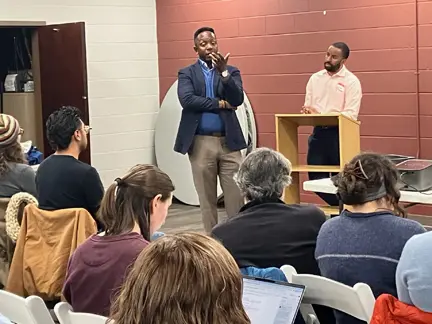
Fifty Atlanta residents came to the Georgia Hill facility on a cold Thursday night, specifically to hear a presentation and ask questions about Mayor Andre Dickens’ Neighborhood Reinvestment Plan. Jacob Pierce of SE Neighbors Take Action invited Courtney English, Mayor Dickens’ representative, to explain Dickens’ proposal to extend the city’s eight Tax Allocation Distircts (TADs) for an additional 30 years.
“We have a tale of two cities,” English declared, and backed this statement with charts and graphs. The goal of the proposal, he said, is to overcome income disparities between neighborhoods that divide the city along lines of race and class. English once served on the Atlanta Board of Education and believes the disparities in education outcomes cannot be overcome inside the schoolhouse. “Housing instability yields low education outcomes,” he said. The mayor wants a city that gives every kid the opportunity to thrive. “This proposal is the only way to create an investment large enough to have an impact on the problem,” he said.
Under the financing program, the city, county, and school tax on the increased value of property within the TAD boundaries is committed to economic development activities directed by the board of Invest Atlanta. The eight districts currently contain 17% of the city’s tax base and that percentage is likely to grow. This shows the success of focused investments over the last 20 years, but the state law authorizing the financing tool limits the property value within the TADs to 10% of the total property value in the city. Therefore, the city cannot create new ones, and if it changes the boundaries of a current TAD, the calculation of the “increment” going into the restricted funds goes back to zero, according to English. “If you start over, the fund would have little income until property values rise again.”
Extending the life of all the TADs for 30 years would produce a collective fund of $5.4 billion. There are three current TADs producing most of the capital. The Beltline TAD brings in the largest amount of revenue—somewhat over $100 million. The Westside TAD yields about $50 million, and the Eastside TAD about $30 million. The Atlantic Station TAD is closed and the bonds used to stimulate its development are paid off. The taxes on this property have increased and now go into the general funds of the city, the county, and APS. English pointed out this project shows the success of using TADs for economic development.
The audience raised a number of concerns.
1. The control of the funds would rest in the unelected board of Invest Atlanta. English said the authority could move more quickly to address the shortage of affordable housing and there are elected officials on the board.
2. A significant number of neighborhoods which need help are not in a TAD district. English said some funds could be funneled back to the three jurisdictions for other investment projects in other areas.
3. A list of neighborhood projects has not been released.
4. This powerful development tool has led to displacement and gentrification. English said funds could be used to abate the taxes of legacy residents and that the Dickens administration was committed to using the funds differently than in the past. He said in the last four years 75% had gone to affordable housing.
5. No commitments from the mayor for rail on the BeltLine.
6. The program took funds from APS. English said funds are flowing back to APS from TAD revenues and could do so by agreement in the future.
7. Taxes would rise on property outside the districts. English did acknowledge that local government should be receiving more revenue from high end commercial property.
8. The commitment of future TAD increments to paying off bonds would limit future administrations.
9. Several residents who agreed with the goals indicated there is a significant of lack of trust holding them back.
The Center of Community Innovation has published an independent review of the facts relevant to the discussion.
Lots of information was presented and lots of questions asked. While the administration tried to rush the legislation through the day before Thanksgiving, the City Council is not likely to act on the mayor’s proposal until further discussions have taken place. There was no indication the proposal would come before the NPUs. A commission (not yet identified) will be in discussions about some of the issues raised. The meeting ended on a positive note with a commitment from English to have further conversations with neighborhood leaders.