By Jeremy Varner
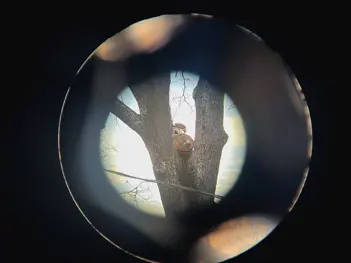
Photo by Jeremy Varner
Red-tailed hawk eating a squirrel
The day after closing on our house, my wife and I were sitting on our new front porch swing figuring out move-in logistics. We saw our new neighbor Steve coming up the sidewalk to introduce himself, and while we were looking in his direction, a red-tailed hawk (Buteo jamaicensis) swooped down out of the sky, zoomed across the street, caught a squirrel in the yard across the street, and then started flying away with its prey. That’s when something interesting happened.
Now this was during the Great Recession of 2008-2009, and believe it or not, the neighborhood was a little different. The property where the hawk attacked the squirrel was tied up in probate court and was vacant, except for the occasional short-term, non-paying guests. The yard was completely overgrown and probably hadn’t been mowed for a couple of years. All that tall grass must have prevented the hawk from getting a good grip on the squirrel because as the hawk took off and ascended to about twenty feet off the ground, the squirrel broke loose and fell into the grass. The hawk flew away without looking back; it must have been embarrassed at losing its pretty prey in front of an audience. I imagine the squirrel went straight to his friends and said, “You’ll never believe what just happened.”
Since then, I’ve seen tons of red-tailed hawks in the neighborhood and throughout the city. The Grant Park sports fields are probably the best place around to watch the birds. I find it very distracting when I’m trying to coach some baseball drills and such majestic creatures are soaring on the wind. It’s a special treat when the sun catches their tails and you can see why they got their name.
I find one of the more interesting facts about birds of prey is that the females tend to be significantly larger than the males. As Helen Macdonald explains in her memoir H is for Hawk, in many hawk and falcon species the male is about 33% lighter than the female so some folks call the male a “tiercel” after the Latin for third. In red-tailed hawks the males are about 25% lighter than their mates. So if you interact with an especially large, imposing red-tailed hawk, a polite “yes-ma’am” or “no-ma’am” is the way to go.
This past week a similar scene unfolded on our street but with a more predictable outcome. Another red-tailed hawk – or, who knows, maybe even the same one if we’re being romantic – caught a squirrel. Except this one did not lose its grip. It carried the squirrel to the limb of a water oak across the street and calmly ate its meal while all the songbirds raised a ruckus to warn their neighbors of danger.
Steve still lives a couple doors away. Grant Park has seen many changes since the Recession, but the same good neighbors and fascinating wildlife remain.