
By Jeremy Varner
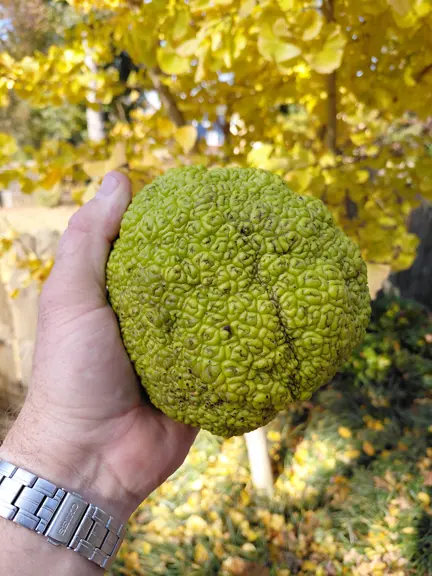
If you have traveled along Boulevard during the last several weeks you may have seen some green balls lying on the sidewalk and in the gutter on the west side of the street near the bus stop just south of Berne Street. They are bright green, a little bigger than a grapefruit, hard, dense, and have a rippled or bumpy surface. But what are they?
James McMurtry is one of the great, under-appreciated American songwriters, and his song “Choctaw Bingo,” which is one of the best songs ever written, includes the description of something hard “like an old bodark fence post you could hang a pipe rail gate from.”
Bodark is the American pronunciation of bois d’arc, formally named Maclura pomifera. It’s a cool tree with many names including Osage orange, hedge apple, or bowwood. The medium sized tree is native to eastern Texas, eastern Oklahoma, and western Arkansas, but grows across much of the Southeast now. The Osage and Comanche peoples used its wood to make archery bows, so the early French traders called it bois d’arc — “bow-wood.”
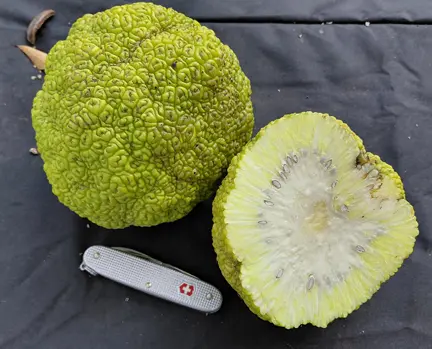
The hard, green fruit is something you might think you would find in the back row of the produce section at Your Dekalb Farmers Market with the durians and jackfruit, not at a bus stop on Boulevard. Despite its many names it is neither an orange nor an apple but is a member of the mulberry (Moraceae) family. When you cut the fruit open it immediately starts oozing copious amounts of latex-like sap. I sampled some of the fruit, but I do not recommend it. Even a small taste leaves your mouth covered in residue like you have been eating wax. Aside from the culinary limitations, cutting it open revealed the seeds individually wrapped but collectively packaged like its much tastier cousin, the mulberry.
Besides bows, folks have used the trees to create living hedges around cultivated fields and used the dried, cut wood for fence posts as the James McMurtry song suggests. The wood is rot-resistant, and I have seen plenty of old bodark fence posts while doing field work in northeast Oklahoma. My copy of Native Trees of the Southeast by L. Katherine Kirkman, Claud L. Brown, and Donald J. Leopold said that Native Americans use the roots to make a yellow dye. I believe it because a few years ago a tree crew was cutting down a specimen at a home on Hill Street and the wood was remarkably yellow, like turmeric, on the inside.
If you are not feeling particularly handy or crafty, I think you could still have fun by collecting a bag of fruit and having an intense game of dodgeball with your buds. There would be no doubt when someone gets hit. They would be down for 36 hours plus.